

Smart Feeder OEM Scaling: Why Samples Work, But Mass Production Fails
By Petoking Team
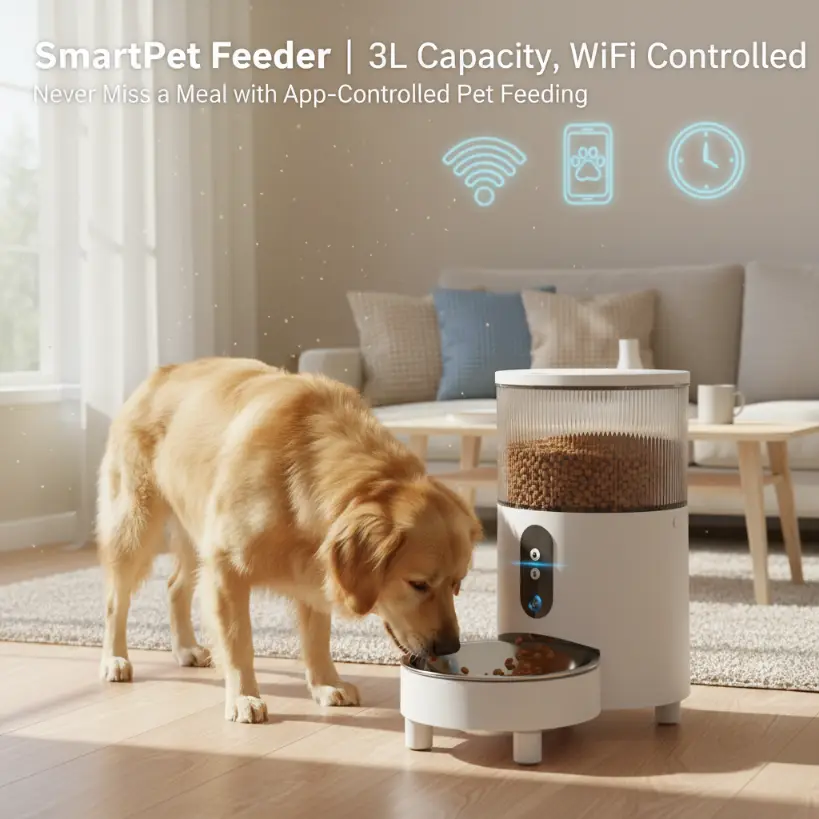
A golden retriever using a Petoking 智能喂食器—highlighting our reliable Smart Feeder OEM Mass Production quality for global pet tech brands.
You’ve approved the samples. The pilot run went off without a hitch. But when you scale to 10,000 units, small flaws pop up—flaws no one saw in the controlled sample phase. Sound familiar? At Petoking, we’ve solved this exact issue for global pet tech brands for over a decade. This isn’t about blaming mistakes—it’s about closing gaps between sample success and the reality of Smart Feeder OEM Mass Production.
- 1. This Isn’t About Failure—It’s About Fixing OEM Decision Gaps
- 2. The Hidden Start of Mass Production Troubles
- 3. Samples vs. Mass Production: Why One Works, the Other Struggles
- 4. Mass Production Risks (and How to Stop Them)
- 5. Component Variation & Handover Issues No Sample Test Catches
- 6. The Responsibility Gap: Who Owns Quality?
- 7. Who Pays When Mass Production Fails?
- 8. Why Most OEM Evaluations Miss the Mark
- 9. What Petoking Does Differently for Long-Term Success
- 10. Conclusion
The gap between samples and mass production isn’t random. Scaling puts stress on parts, assembly lines, firmware, and quality checks for 智能喂食器s. Catching issues early saves rework, lost sales, and brand damage before large-batch shipping for Smart Feeder OEM Mass Production.
In today’s pet tech market, passed samples don’t equal production readiness for Smart Feeder OEM Mass Production. What works for 50 智能喂食器 units fails for 5,000. Hidden costs—from component variations to inconsistent sensor performance—lurk in this gap.
| Key Takeaways - Passed samples ≠ readiness for Smart Feeder OEM Mass Production - Scaling issues for 智能喂食器s emerge after pilot runs - Early risk checks save time, money, and brand trust in mass production |
1. This Isn’t About Failure—It’s About Fixing OEM Decision Gaps
This isn’t a technical manual or a rant. It’s about how brands misjudge OEMs for Smart Feeder OEM Mass Production—too many brands assume “passed samples = reliable partner,” planting seeds for future 智能喂食器 issues.
This complacency fuels hidden risks—and Petoking helps brands look beyond samples to assess real production capability.
2. The Hidden Start of Mass Production Troubles
Failures in Smart Feeder OEM Mass Production don’t come out of nowhere—they start right after sample approval. A WiFi-enabled 智能喂食器 may work perfectly in office tests, but scaling uncovers variables hidden in small batches.
Why Passing Samples Feel Like Progress (But Often Aren’t)
Perfect 智能喂食器 samples breed false confidence: a tiny motor adjustment irrelevant for 100 units can jump to a 5% defect rate when scaling to 10,000 units in Smart Feeder OEM Mass Production.
| Mini Case Example One Petoking client’s WiFi 智能喂食器 passed all sample tests, but batch vs. manual sensor calibration caused a 3% misdispensing rate in Smart Feeder OEM Mass Production. We resolved it by adding dedicated batch calibration checks. |
3. Samples vs. Mass Production: Why One Works, the Other Struggles
智能喂食器 samples are hand-assembled—engineers select top parts, tweak firmware individually, and calibrate sensors one by one. Smart Feeder OEM Mass Production removes these safety nets, letting variations creep in.
What Changes When You Scale 智能喂食器 Production?
| Sample Stage | Mass Production Stage |
| Hand-checked circuit boards | Automated assembly lines |
| Manual sensor tuning | Batch calibration for hundreds of units |
| Selected motors (no variation) | Mixed motor batches from suppliers |
| Controlled lab environment | Multiple factories, shifts, and supplier changes |
These small discrepancies add up quickly for 智能喂食器s. A 0.1mm part difference may not impact samples, but across 10,000 units in Smart Feeder OEM Mass Production, it leads to jams or misfeeds.
4. Mass Production Risks (and How to Stop Them)
Scaling issues for 智能喂食器s aren’t one-time glitches—they’re systemic risks amplified by volume in Smart Feeder OEM Mass Production. Petoking stops these risks early.
| Key Risks & Fixes for Smart Feeder OEM Mass Production - BOM changes: Suppliers swap parts without notice. Fix: Lock BOMs early and test alternate parts during pre-production for 智能喂食器s. -Inconsistent calibration: Batch tuning drifts. Fix: Real-time calibration monitoring for 智能喂食器s. - Multi-shift errors: Process inconsistency. Fix: Standardize SOPs and cross-train all shifts for mass production. |
Our “step-by-step quality checks” monitor every stage of Smart Feeder OEM Mass Production—not just finished 智能喂食器 units—to keep these risks in check.
5. Component Variation & Handover Issues No Sample Test Catches
Tiny component variations matter for 智能喂食器s—even slight sensor or resistor changes disrupt feeding accuracy. Supplier substitutions, common in Smart Feeder OEM Mass Production, go undetected in sample testing.
Handover gaps between engineering, production, and QA—missing docs, tool differences, blurred roles—undermine quality, even with perfect samples.
Petoking addresses this with a dedicated project manager for Smart Feeder OEM Mass Production: one team oversees the process from 智能喂食器 sample to shipment, eliminating buck-passing.
6. The Responsibility Gap: Who Owns Quality?
Harsh truth: Brands absorb the costs of Smart Feeder OEM Mass Production failures, not OEMs—because responsibility is too fragmented for 智能喂食器 projects.
Engineering relies on QA, QA on production, and procurement on pre-testing—no one owns quality, leaving your brand to handle customer complaints and returns.
| Fix It With Clear Ownership for Smart Feeder OEM Mass Production - Define quality ownership upfront (our project managers own it for 智能喂食器 projects). - Set rules for approving component or process changes in mass production. - Tie quality metrics to OEM performance for 智能喂食器s. |
7. Who Pays When Mass Production Fails?
Failure costs in Smart Feeder OEM Mass Production extend far beyond rework. You’ll face:
- Customer complaints and returns
- Lower ratings on Amazon or your website
- Delays launching new products
- Damaged trust with retailers and investors
We’ve seen brands lose six months of growth fixing Smart Feeder OEM Mass Production scaling mistakes—build quality into your 智能喂食器 process from day one.
8. Why Most OEM Evaluations Miss the Mark
Brands evaluate OEMs for Smart Feeder OEM Mass Production based on samples or small pilot runs, but these don’t prove an ability to make 10,000 identical 智能喂食器 units.
Rethink your evaluation for Smart Feeder OEM Mass Production by asking critical questions: How do you test batch consistency for 智能喂食器s? How do you handle supplier component changes in mass production? Can you share data from past Smart Feeder OEM Mass Production runs?
9. What Petoking Does Differently for Long-Term Success
Strong Smart Feeder OEM partnerships rely on systems, not just samples. Petoking turns 智能喂食器 sample success into consistent Smart Feeder OEM Mass Production with three core steps:
- Pre-Production Validation: Test batch variation, tool stability, and process repeatability for consistency before scaling—no “hope-based” production.
- End-to-End Ownership: A dedicated project manager oversees the process from 智能喂食器 sample to shipment—fast issue resolution and full transparency.
- Real-Time Quality Checks: Monitor every step from component arrival to assembly—with accessible real-time data.
| Mini Takeaway Scaling 智能喂食器s requires systems that keep every unit as reliable as the first sample during Smart Feeder OEM Mass Production. |
10. Conclusion
Approving 智能喂食器 samples isn’t the finish line—it’s where the risk of Smart Feeder OEM Mass Production begins. Scaling tests your processes, your partner, and your ability to protect your brand.
Key question: Does your OEM have the systems to deliver in Smart Feeder OEM Mass Production—the true test for 智能喂食器s?
| 资料下载 Petoking’s Free Smart Feeder OEM Quality Checklist Avoid scaling mistakes in Smart Feeder OEM Mass Production with our pre-production checklist (batch testing, component validation, quality ownership). 资料下载 Now |
Petoking simplifies Smart Feeder OEM Mass Production scaling. Let’s turn your perfect 智能喂食器 sample into a consistently reliable mass-produced product. Contact Our Team